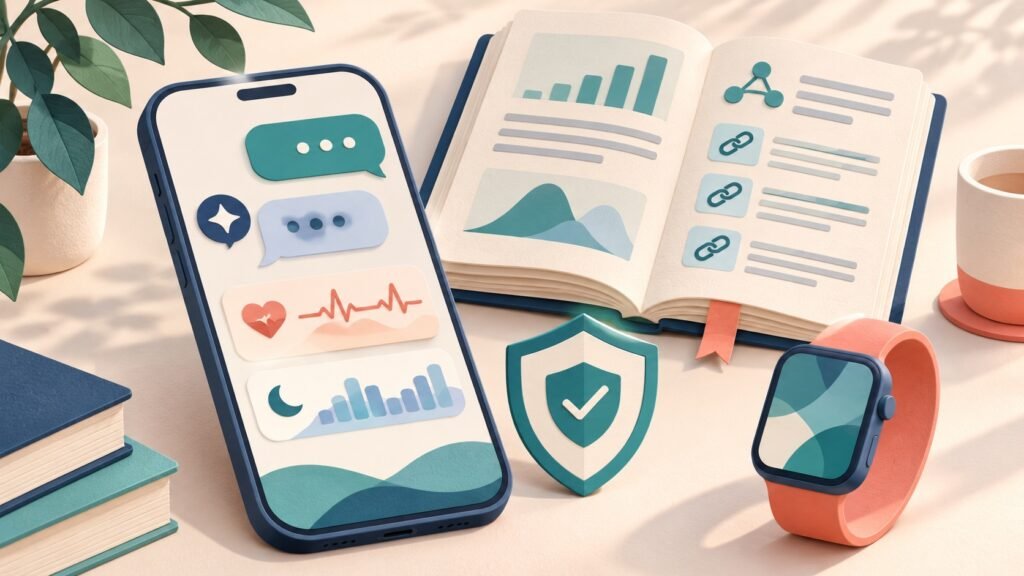
The Apple Health AI Study is a new research project examining how people understand and use answers from health-focused artificial intelligence. Announced on November 15, 2026, the Apple Health AI Usage Study pairs an Apple-designed iPhone experience with clinical AI technology from OpenEvidence.
The important distinction: this is a voluntary US research study, not a worldwide launch of an AI doctor inside Apple Health. Here is who can participate, what information they can choose to share, and what the announcement means for Australian Apple users.
What is the Apple Health AI Study?
According to Apple’s official announcement, researchers want to examine trust, response quality, comprehension and everyday health actions. The question is not simply whether a chatbot can produce a medical-sounding answer, but whether people understand it and use it appropriately.
Participants can ask everyday health questions through a dedicated study app. OpenEvidence supplies technology grounded in medical research, including sources such as the New England Journal of Medicine, JAMA and Nature. Answers include links to peer-reviewed clinical citations, allowing participants to inspect their supporting evidence.
Apple will also explore whether this experience helps people prepare for appointments with their own doctors. These are research aims, not proof that the app improves health outcomes.
Who can join, and which iPhones qualify?
Apple says the study is open to up to 200,000 eligible participants aged 21 and older across the United States. Participants need:
- An Apple Intelligence-enabled iPhone.
- iOS 26 or later.
- Eligibility under the study’s enrolment requirements.
Apple describes the hardware requirement as iPhone 15 Pro or later. Importantly, that does not mean every iPhone 15 qualifies. Apple’s Apple Intelligence compatibility guidance lists iPhone 15 Pro and iPhone 15 Pro Max, iPhone 16 models and later, plus iPhone Air and iPhone Duo. The standard iPhone 15 and iPhone 15 Plus do not support Apple Intelligence.
The announcement does not list an Apple Watch as a compulsory enrolment device. An eligible iPhone is the stated device requirement; having a compatible Mac or iPad alone is not enough.
What health information can participants share?
Participants can choose to share supported HealthKit information, such as resting heart rate, activity, sleep or lab results. Apple wants to investigate whether personal data makes answers more relevant and easier to understand.
That choice matters. Asking a general question and authorising access to a personal health history involve different privacy decisions. Participants retain control over whether to share HealthKit metrics or survey responses, rather than being required to share every available category.
Apple Health can already contain information from multiple sources. Our guide to syncing Fitbit data through Google Health to Apple Health explains one example. Before joining any research project, review what is actually stored on your phone and which permissions you are comfortable granting.
Privacy protections: what Apple promises
Apple says study data will not be used to train AI models. It also describes security measures for the study information it maintains and safeguards intended to protect participants’ confidentiality.
TechCrunch’s reporting adds that information is anonymised before being sent to a secure third-party cloud provider, and that OpenEvidence deletes question-and-response data after 24 hours.
Those statements should not be stretched into a claim that every study record disappears after a day, or that everything happens on the iPhone. The official App Store listing separately identifies a user ID as data that may be linked to a participant, alongside diagnostic information that is not linked. Read the study’s consent and privacy documents to understand the different data flows before enrolling.
Why this is not an AI doctor
Apple explicitly says the app is not intended to diagnose or treat conditions, replace medical professionals, or provide a substitute for checking health concerns with a clinician. The App Store description similarly states that neither the app nor the study provides medical advice, diagnosis or treatment.
Clinical citations are useful, but they do not guarantee that an answer is complete or appropriate for an individual’s circumstances. Apple acknowledges that consumer health tools powered by large language models can produce incomplete or unclear responses.
The app includes guardrails intended to recognise certain concerning questions and suggest professional help or other resources. Treat these as safeguards under evaluation, not a guarantee of safe triage. Do not change treatment or delay seeking care because of a chatbot answer.
What should Australian Apple users do?
The announced study is US-only. Apple has not announced an Australian enrolment date in this release, so owning an eligible iPhone in Australia does not establish eligibility.
There is no reason to buy a new iPhone or install beta software solely for this research announcement. For eligible US readers who are interested, use the official app listing, verify the developer is Apple Inc., and review the study information before choosing to enrol.
This is also separate from broader Siri AI app integrations. The announcement does not confirm that this particular health-chat experience is coming to Siri or to every user’s Health app.
Final thoughts
The study’s most useful idea is measuring understanding and appropriate trust, not just generating answers. For now, it remains a limited US research programme with optional health-data sharing and clear medical limitations. Australian readers should watch for official availability updates rather than assume a global rollout.
FAQs
Can Australians join the Apple Health AI Study?
The announced programme is for eligible US participants. No Australian launch date is included.
Does a standard iPhone 15 qualify?
No. It lacks Apple Intelligence support. The iPhone 15 Pro and Pro Max are supported models.
Why does the app show 18+ if the study requires 21+?
The App Store content rating is separate from research eligibility. Apple’s study announcement sets the participation age at 21 and older.
Will the study train AI models on my data?
Apple says study data will not be used to train AI models. Review the consent documents for collection and retention details.
Can the app replace a doctor’s appointment?
No. It is a research tool, not a diagnosis or treatment service.
Leave a Reply